TLDR: Solana MEV bots make their money by prioritizing and selecting certain transactions to enter a block. On Solana this would include doing atomic arb in between DEX pools, running backruns on large trades and liquidations of undercollateralized positions. It works thanks to Jito bundles, which allow the bot to land its transactions on top of a block. Unlike in Ethereum there is no public mempool on Solana. In other words, MEV is about seeing the state of the network sooner and getting in first, rather than monitoring other people's pending transactions. The guide below explains what MEV is on Solana, key strategies, the infrastructure they run on, and the economics of making money on them.
Key Takeaways
- Solana MEV primarily comes from Jito bundles: up to five atomic transactions that enter a block, ordered by their tip and executed at the top of a block issued by a Jito-compatible leader.
- There is no mempool on Solana. The advantage comes from the ability to see the confirmed state and in-flight shreds earlier, and from landing first, not from reading pending transactions on the mempool. OrbitFlare Apex is the landing side of that: regional endpoints with leader-directed routing across partner validators, direct TPU and Jito.
- The key strategies are atomic arb, backrun and undercollateralized position liquidations.
- The profitability is affected by three key costs: tips, priority fees and failed submissions. Running simulations before submission helps with the last point.
What MEV means on Solana
MEV, maximal extractable value, is the additional profit that you can capture by selecting particular transactions and ordering them in the blocks. Solana blocks are issued fast (around 400 milliseconds per slot) and the rotation of leaders happens every fourth slot. Hence, there is little time to decide on the ordering of transactions. The tool to set the ordering on Solana is the Jito block engine.
Jito modifies the validator's software (now available both in Jito-Solana and BAM flavors) that allows the leader to accept bundles of transactions from searchers (i.e., bots in our context), auction these bundles off chain for each upcoming slot and order them according to the result of such auction, putting winning bundles at the beginning of the block. The searcher pays the bid to the leader; it is shared by the leader with stakers. This auction is where most of Solana's MEV is captured.
Practical notes for a bot builder:
- You can run your transactions as one bundle with order guarantees: the bundle enters the block or does not at all;
- The key objective is to win an auction by bidding (tips), not just beat competitors via faster connections;
- Your submission can be picked only by Jito compatible leaders: they now have some 54% of the stake in the ecosystem (as of the end of Q2 2026);
Jito bundles and tips explained covers all the Jito specifics.
Why there is no mempool, and what replaces it
Ethereum MEV relied on the public mempool in which the searchers watched pending transactions and positioned transactions around them. The mempool does not exist on Solana. The transactions are sent to the leaders from the clients through QUIC protocol and broadcast only once they get into a block. You cannot observe other people's swaps before they execute;
The replacement for the mempool is the ability to see the confirmed and in-flight state earlier: the leader broadcasts shreds that are parts of the block it is building. The bot that reads the shreds sees swaps, new pools and oracle updates while the block is still being assembled, before a regular Solana node processes them. That head start is what the bots compete for. That is why the MEV conversations on Solana focus on Shredstream and feeds derived from shreds such as Jetstream gRPC.
The strategies
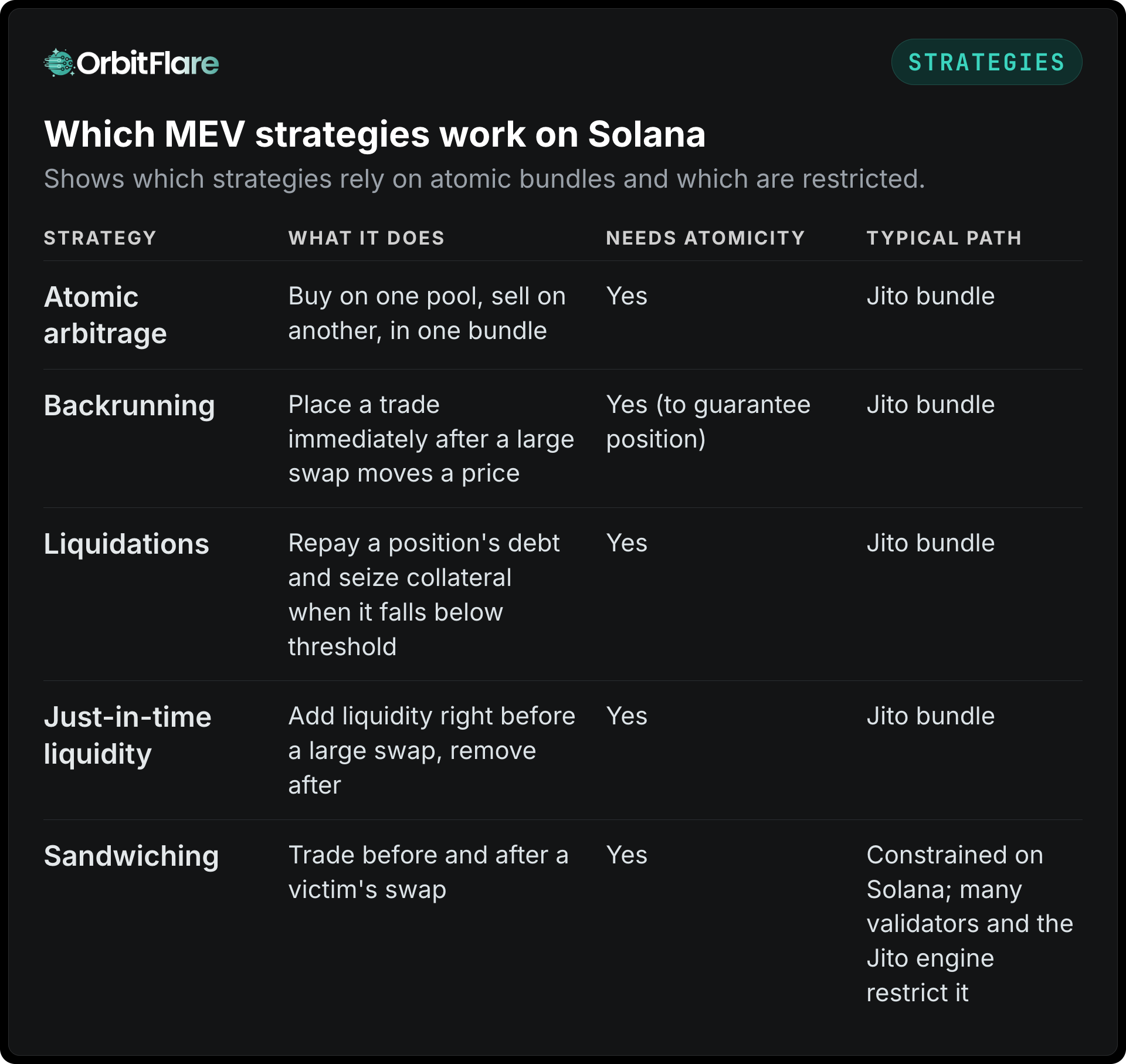
Atomic arbitrage is the most popular: the prices in Solana DEX pools deviate. The atomic bundle that runs the transactions buying at lower and selling at higher price captures the difference. There is much competition and your advantage comes from spotting it first and bidding accordingly.
Backrun is a reaction to the big swaps moving the prices; your bundle contains the trades benefiting from the newly formed price right after the triggering transaction. Think of it as a cousin of a front run in an environment without the mempool.
Liquidations are the most defensible MEV to pursue. There is a bonus in lending protocols that goes to whoever closes the undercollateralized position. It is about observing the oracle update and running a bundle to seize the assets first. Check the guide on Solana liquidations if you consider this.
Sandwiching is a theoretically possible way when you predict the outcome of a particular trade on the exchange and position around it in a bundle. The information is limited due to no-mempool nature, and it is additionally restricted by Jito's policy and validator settings. This strategy is also the most likely to attract the regulatory attention. The guide below does not describe how to run sandwiching strategies.
The infrastructure behind a MEV bot
A MEV bot is a trading bot optimized for fast execution with a built-in bundle constructor. It uses a very similar architecture to that of a Solana trading bot with some peculiarities.
Read side: get shred-level feeds on the events you race on (swaps, oracle updates) and Yellowstone gRPC for DEX pool state that you want to get as accurately as possible (pool reserves and tick arrays, oracle account). Having a stale view of the latter results in failed bundles.
Simulation. Each bundle is simulated in your local environment and after that, again by the block engine. Failures give you an idea of how fresh your view of the blockchain is and whether your bids were competitive.
Write side. Submit Jito bundles to the closest block engine region. Set the bids on each bundle based on its edge (that was estimated in simulation).
Placement. Place your setup geographically close to the stake and to block engines. Frankfurt, Amsterdam, and the East Coast of the US are the usual candidates. Multiregional deployment helps as the leader rotates worldwide; the guide on Solana low-latency infrastructure covers the topic of route optimization.
Dedicated capacity. Advanced traders deploy the dedicated nodes that often have the Jito software installed for observation and submission of Jito bundles to the leader bypassing shared infrastructure completely.
The economics
A MEV bot profit is calculated as the value it extracts, minus the three costs, all controlled by you.
Tips. The bid in the auction described above. If it is too low you miss the opportunity; if it is too high you give the edge away to the validator. Size the bid out of the simulation of each individual bundle.
Priority fees. Not required if the transaction is in a bundle because the block engine sorts transactions inside bundles by tips only; however required for anything else. They are lower than the tips usually are for the typical strategies.
Failed attempts. Failed simulations result in zero-costs; failed auctions result in zero-costs; but the engineering and infrastructure costs of each attempt are real. A strategy having many failed simulations suggests that your read-side is too slow. Track your attempts, failed attempts, failed auctions and successful bundles separately.
The reality: obvious opportunities are competitive, margins are thin, and profitable bots are the ones with the fastest read side, the tightest simulation and flexible tip calculation.
Risks and responsibilities
- Capital at Risk. Your bundle lands at a worse price than it was estimated in simulation, or a better-placed bot front-runs your liquidation: you lose money. Caps per bundle and per day are not optional.
- Protocol and Validator Policies. Jito protocol and individual validator policies can and do limit the strategies. Build according to rules.
- Regulatory. MEV is under scrutiny in many jurisdictions. This guide is about technicalities only.
Conclusion
Solana MEV results from Jito bundles and comes from seeing the confirmed state of the blockchain earlier than your competitors since there is no mempool on Solana to look at. Atomic arb, backrun, and undercollateralized position liquidations are the strategies that comply with the current rules. All of them require the shred-level read-side, tight simulation, bidding per-bundle, and the placement close to the stake.
The read side of a MEV bot on Solana is provided by Jetstream gRPC and Shredstream; for the write-side options and the broader comparison of paths to the leader, see Solana MEV relayers compared.