

Solana RPC for AI Agents: MCP, Tools and Guardrails
An AI agent acting on Solana needs a read path, a write path and guardrails, exposed as typed tools through MCP with keys and limits held outside the model. What agents need from infrastructure, how to expose it, and the guardrails that keep an autonomous agent safe.
Sourav Mishra · Solutions Engineer
Sep 5, 2026 • 7 min read


Solana Infrastructure for AI Agents: Reads, Sends and Guardrails Through MCP
An AI agent acting on Solana requires exactly the same components a trading bot requires, arranged in a way safe for the language model to use: a read path to current chain state, a write path to land transactions, and guardrails that bound the agent's spending and signature power. In 2026, this means an MCP (Model Context Protocol) server and tools wrapping the provider's RPC, gRPC, and transaction-landing endpoints, keeping keys and limits on the server side. Here we cover what exactly an agent needs from Solana infrastructure, how to expose it via MCP and tools, latency and cost issues, and guardrails that prevent an autonomous agent from turning into a costly incident.
What an AI agent needs from Solana infrastructure
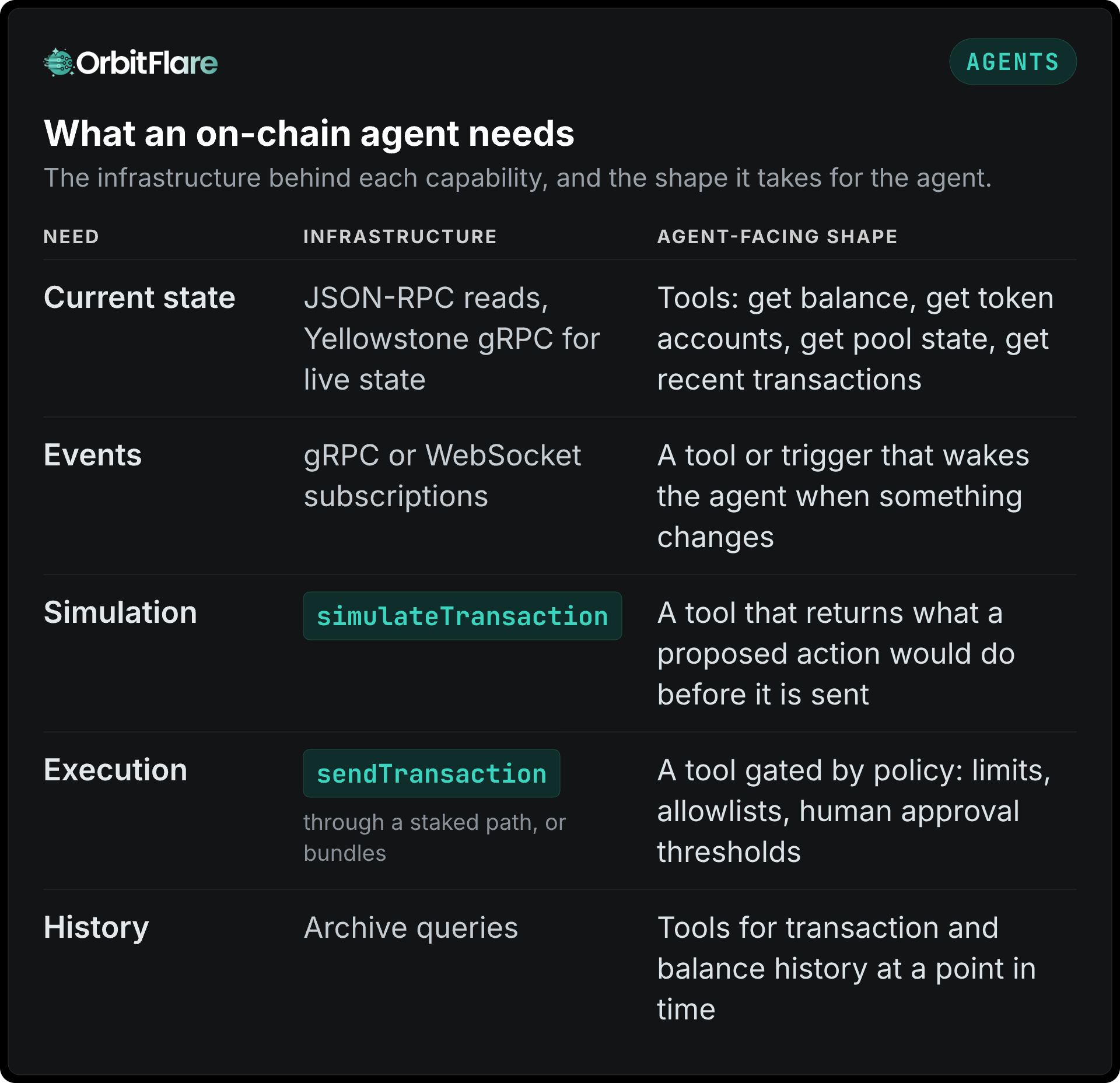
The column on the right is the relevant one. A model can reason well on structured results and terribly on raw account bytes, and must never be able to construct a transaction from a raw RPC endpoint. Each capability is a tool, and the schema is where the guardrails live.
MCP: the standard interface
MCP allows a model to discover and invoke tools provided by a server via a standard protocol. In case of Solana, an MCP server wraps a provider's endpoints and exposes various tools, including get_account, get_token_balances, simulate_swap, send_transaction and others, each with typed inputs and outputs.
OrbitFlare provides an MCP server and agent tooling for its endpoints; docs.orbitflare.com/agents describes the installation procedure and the available tools, including the CLI and SDK versions. The principles described below are applicable whether you use that server or implement your own.
Keep credentials on the server side. The MCP server stores the RPC key and, in case the agent is allowed to sign, the signing key or delegated signer. The model sees the tool names and results, but never the secrets.
Make reads broad and sends narrow. Expose many read tools with generous limits and one or two send tools with strict policy. The agent should be able to explore anything freely and only able to act through a gate.
Return structured and decoded data. Decode token accounts, pool reserves and transaction metadata on the server side. Passing raw base64-encoded strings as the tool result wastes the context and is prone to misunderstandings.
Guardrails that belong to the tool layer
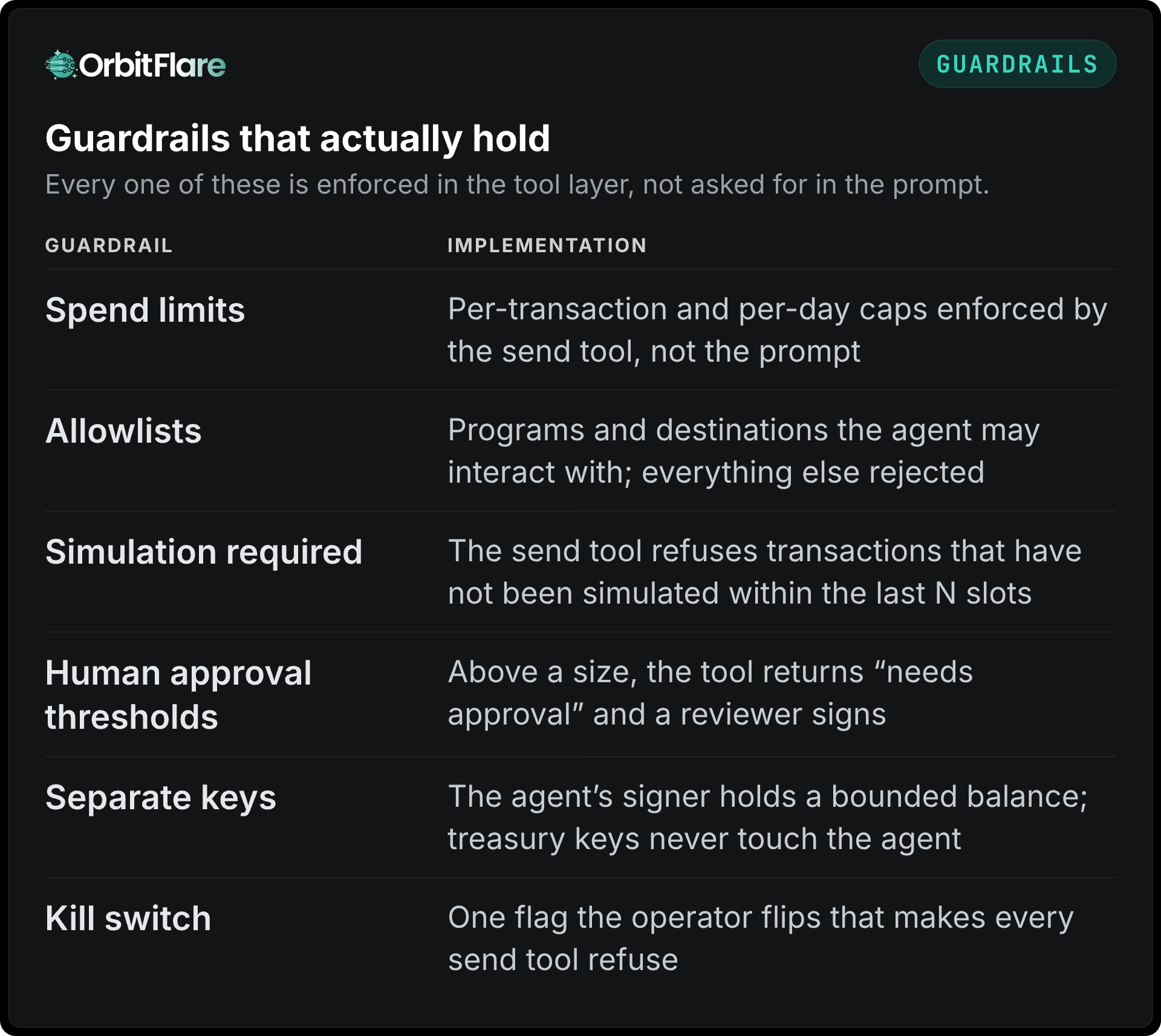
A prompt is not a guardrail. You can talk the model out of following the prompt instruction; but you cannot do that when the limit or cap is enforced on the server side in the code.
Latency: slower than a bot, but not optional
An agent's workflow consists of observe, reason, act stages, with the reason step requiring hundreds of milliseconds to several seconds. This is much slower than a trading bot, leading some teams to think that the latency issue can be completely ignored here. But it cannot, because of the following reasons.
First, outdated observation gets amplified by the long reasoning time: an agent reading a pool price, thinking for three seconds and acting upon it acts based on the price several slots old. Provide the agent with a fresh read immediately prior to sending, with a simulation returning an error in case the state moved.
Second, an event-driven agent requires prompt wake-up. An agent reacting to a wallet movement or a governance proposal should be triggered by a subscription (Yellowstone gRPC or WebSockets), not a polling by a timer.
For agents doing trading, the execution path is the same as for bots: a staked submission lane to avoid dropping the transaction under the load.
Cost: agents are very chatty
A model exploring the problem can invoke a dozen of read tools per step. When multiplied by steps and number of agents, it will consume the entire request budget. There are three ways to handle it.
- Cache on the server side. Account reads that were not changed since the last slot require no additional RPC calls; and a Yellowstone subscription keeps the cache hot.
- Batch in the tool. A
get_token_balancestool should do a singlegetMultipleAccountscall, not a separate one per account. - Prefer a pricing model that does not weight methods. Agents call expensive methods (
getProgramAccounts, history) freely; while credit-based pricing penalizes that.
A reference setup
- Provider endpoints: a keyed RPC URL, a Yellowstone gRPC endpoint, and a staked send path, all in the region close to your agent's host.
- MCP server with stored credentials, exposing decoded read tools, a simulation tool, triggers for subscriptions and a policy-gated send tool.
- Agent runtime (any model with tool invocation) with the MCP server, a limited signing key and the kill switch checked on every send.
- Observability: every tool invocation logged with input parameters, result, latency and cost, so you can trace what the agent did and why.
- Evaluation: re-run recorded tool invocations trace against new prompts or models.
Conclusion
Solana infrastructure for AI agents is exactly the same read, write and guardrails stack as a bot, provided as typed tools via MCP with credentials and policy on the server side. Give the agent broad, decoded and cached reads; mandatory simulation step; and a narrow, limited, allowlisted send path with a kill switch. Trigger it by subscriptions rather than timers, and price for the chatty access.
Documentation of OrbitFlare's agents has the MCP server and SDK. The RPC plans and gRPC service are the provider endpoints behind it.
Resources
FAQ
With spend caps, allowlists, mandatory simulation and a bounded signer enforced in the tool layer, an agent can execute within a policy safely. Without those, it is an unbounded liability regardless of how good the prompt is.
You can, and you should not. A raw endpoint gives the model every method with no limits and no decoding. MCP or an equivalent tool layer is where structure and guardrails live.
Any model with reliable tool use. The infrastructure and guardrails matter more than the model; a careful tool layer makes a mediocre model safe and a great model useful.
Through subscriptions surfaced as triggers: the MCP server holds a gRPC or WebSocket subscription and wakes the agent with a structured event. Polling on a timer is slower and burns budget.
Yes. The [agents documentation](https://docs.orbitflare.com/agents/overview) covers the MCP server, CLI and SDK, and the tools they expose against OrbitFlare endpoints.
Sign with a treasury key, send without simulation, exceed a cap, or interact with a program outside its allowlist. Encode each as a refusal in the send tool.
Solana RPC for AI Agents: MCP, Tools and Guardrails
Related articles
Agave 4.2: Transaction V1 Breaking Changes Checklist
Six things that break when Transaction V1 activates on Solana mainnet, and only one of them throws an error. What fails, how it fails, what to change, and the library versions to pin.
DevelopersSolana WebSockets vs gRPC: When to Switch and How
WebSockets and Geyser gRPC both push Solana updates. They differ in where they tap the node, how they encode, how they filter and how far they scale. When each is right, and a one-subscription-at-a-time migration path.
DevelopersgetProgramAccounts Alternatives: Stop Scanning, Start Streaming
getProgramAccounts is the most expensive and most limited method in the Solana RPC API, and most calls to it should be a gRPC subscription, an indexer query, getMultipleAccounts, or a provider index. Why it is costly and the alternative for each use case.