In short, a Solana validator votes on blocks and, in proportion to the stake delegated to it, takes turns producing them. It earns rewards from protocol inflation and, if it uses the Jito client, from MEV tips, and distributes them to its delegators after taking a commission. For a user of the platform who stakes SOL, the choice of validator matters for their yield and downtime risk; for the one building applications on Solana, validators are where their transactions go in the end. This article describes how validators work, what they earn, what the numbers about performance mean, and how to choose a validator to delegate to.
Key takeaways
- A validator earns two streams of income: from voting, which brings inflation rewards, and from running the Jito client, which makes it eligible for MEV tips. Both are shared with delegators, after commission.
- A validator’s commission is only part of the story. Even a 0% validator that skips a lot of slots can pay less than a 5% validator that never misses a slot.
- Delegating does not move your SOL. It delegates your stake’s voting and leading weight to the validator, and you control your tokens; you can change delegation or unstake them. Activation and deactivation occur at epoch boundaries.
- The numbers that predict your yield are skip rate, vote credits, uptime, and commission, in that order of how often they are overlooked.
What a validator does
Every validator runs the Solana client with a vote account and stake delegated to it. That gives rise to two functions.
Voting. Every block the validator sees, it sends a vote transaction confirming it. Voting is how the network achieves consensus and how a validator earns vote credits every epoch. Votes cost SOL in transaction fees, so a validator that is not staked with SOL loses money.
Leading. The leader schedule for every epoch assigns slots to validators in proportion to their stake. When a validator gets a turn, it produces four consecutive blocks (about 1.6 seconds in total) by gathering the transactions, sorting them and sending the block through Turbine. The performance of a validator as a leader is measured in its “skip rate”, which is the share of assigned slots in which the validator failed to produce a block.
It should also be mentioned that the leader rotation is why latency on Solana is relative to a moving target, a theme that runs through network infrastructure for low-latency trading.
How validators earn
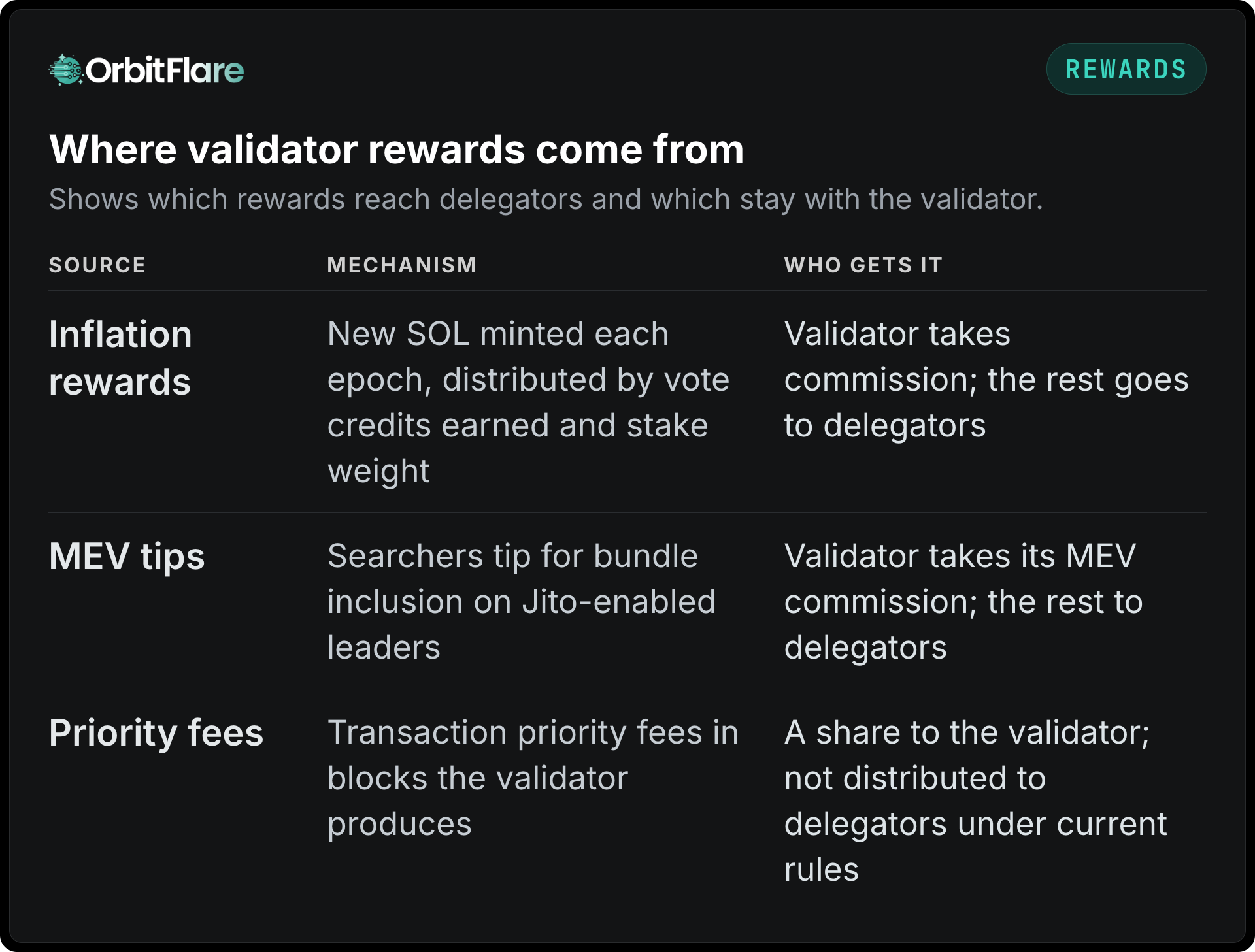
Inflation rewards form the steady basis, which depend on the network inflation, the stake share and voting performance of a validator. MEV tips are the variable part, which depends on the validator running the Jito client and the network activity in general; for more detail about the latter, see Jito bundles and tips explained.
Rewards accumulate every epoch boundary (which occurs every 2-3 days) and are automatically compounded, if you do not remove them from staking.
How delegation works
Delegating to a validator creates a stake account, which you control and is allocated to the validator’s vote account. Your SOL is not sent anywhere, so a validator cannot use it. What a validator receives is the voting and leader-schedule weights of your stake.
- Activation. The new stake is activated at the next epoch boundary, but there is a warm-up limit per epoch.
- Deactivation. Withdrawal of the stake occurs the same way, but in the opposite direction. You need to plan on a few days for redelegation to complete.
- Risk. Solana does not have slashing at the moment, so delegating to a bad validator means losing rewards, not principal. In other words, a bad validator lowers your yield.
Most wallets support native staking. The page of Stake SOL helps to stake using the validator of OrbitFlare, and the staking calculator predicts your yield and compares validators.
The performance numbers and what they mean
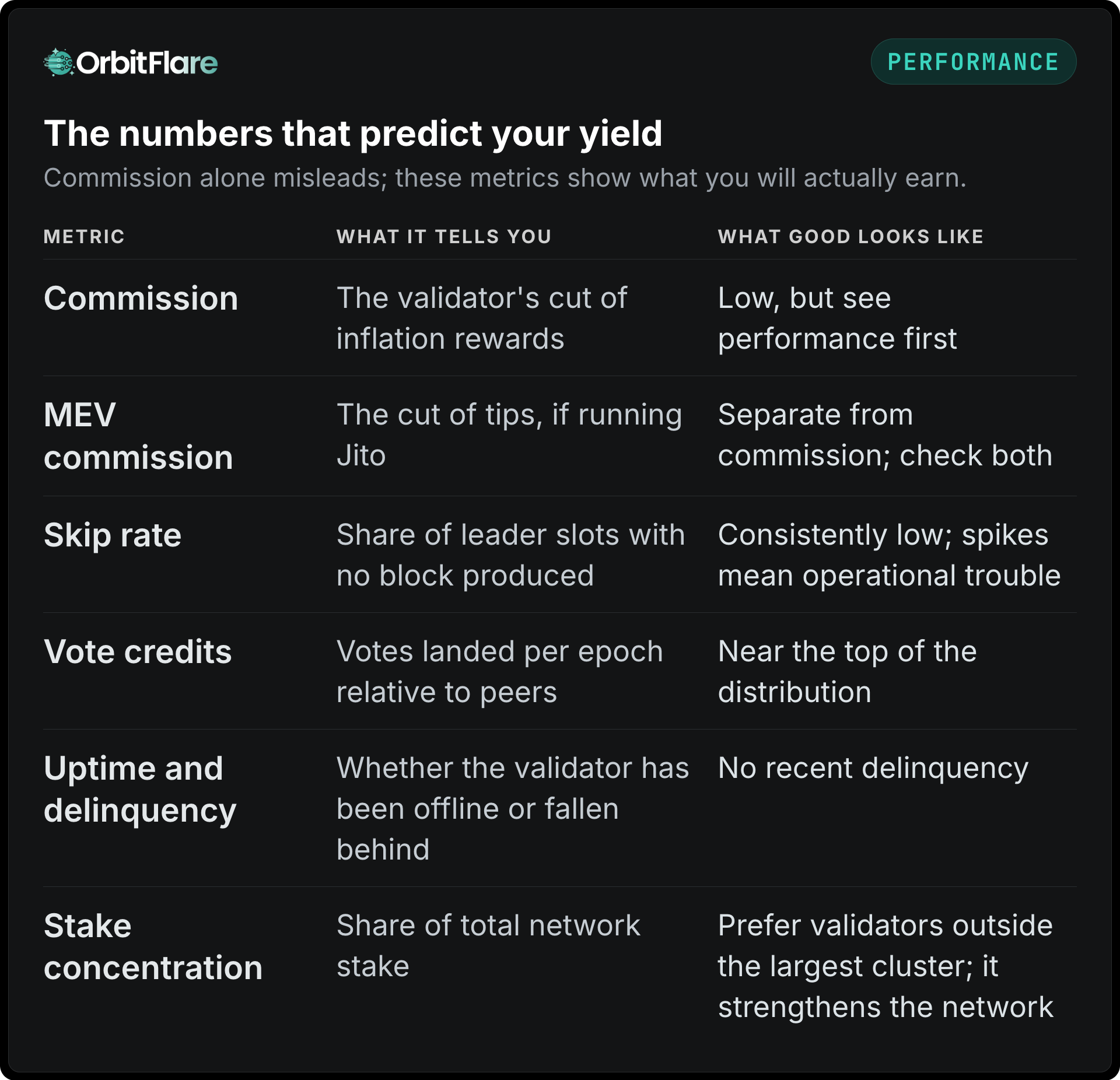
The trap is to evaluate on the commission rate alone. A 0% validator that skips slots and votes too late receives fewer credits and therefore pays out less. Another trap is that a validator which advertises a low commission rate to lure more stake and raises it later is a well-known practice. Always check the commission history, not just the current commission rate.
How to choose a validator
- Filter by performance. Low skip rate on several epochs, close to the maximum amount of vote credits and no recent delinquency.
- Then compare commission rate and MEV commission rate together. A validator that runs the Jito client with a reasonable MEV commission rate will usually out-earn a non-Jito validator with lower commission.
- Check the validator’s operator. Who operates it, where the hardware is, if there is information about the configuration. Anonymous validators with no track record are a risk to your yield, not principal, but still a risk.
- Consider decentralisation. Delegating to validators that do not belong to large stake pools contributes to the network, and some validators are selected specifically for that.
- Re-check every one or two epochs. Performance can change; a validator that was top-performing in the previous quarter can stop doing it now.
The staking calculator does the bulk of work automatically: it fetches the performance and commission rate of the validators you chose and predicts the difference in yield.
Running a validator yourself
Operating a validator is a business with an internal operational challenge. You will need current generation hardware (fast NVMe, lots of RAM, many CPU cores and good bandwidth), a data center that is located near other stake, monitoring to catch slot lag before it becomes delinquency, and plans for frequent client updates. Also, you need delegated stake to earn anything at all, and attracting it requires a performance record and a public presence.
Most people who want exposure to validator rewards prefer to delegate. As for the technical side of operating validators, the article of Solana node types explained contains details on what it needs vs regular RPC nodes.
Conclusion
A Solana validator votes, takes turns producing blocks in proportion to the stake, and earns inflation rewards and MEV tips, which it distributes to delegators after commission. Delegation assigns your stake’s weight, without transferring your SOL, and the choice of validator affects your yield through skip rate, vote credits and uptime, way before the commission rate even enters the picture. Filter by performance, then by commission and MEV commission rate, check the operator and re-check every few epochs.
To verify the numbers yourself, run two validators through the staking calculator. To delegate to ours, the validator page provides everything you need.