

How to Run a Solana Validator: Hardware, Setup, Operations and Economics
Running a validator is an infrastructure business: current-generation bare metal near stake, a deliberate client and key setup, testnet first, permanent operations, and a runway until delegated stake makes it pay. The full picture and the honest alternative.
Sourav Mishra · Solutions Engineer
Oct 12, 2026 • 9 min read



How to Run a Solana Validator: Hardware, Setup, Operations and Economics
Running a Solana validator requires managing a highly capable server staying synchronized with the chain, casting votes on every new block, and generating blocks on time, while gathering enough delegated stake to be profitable. The technical aspect of configuring can take only a day, but running a validator is a lifelong dedication to hardware, networking, upgrading, and monitoring. Only once a validator gets a trusted name from delegators does the business pay off.
This guide will cover hardware requirements, the step-by-step setup process, operations details, economic factors, and the honest decision if you should consider running a validator or delegating the stake.
Key takeaways
- Mainnet validator needs latest hardware: fast NVMe drives, large RAM, lots of CPU cores, and sufficient network throughput located in the proximity of large stakes. Cloud VMs and home Internet connection usually lack the required performance.
- Voting consumes SOL daily. Until the validator becomes profitable from the delegated stake, its operation costs money; prepare for such period.
- Operations impact validator's reputation: skip rate, vote credits, delinquency are published and considered by delegators when choosing a validator.
- Perform a testnet operation, go through release candidate (RC) phase one or more times, and only then switch to mainnet with monitoring in place.
Should you run one?
Consider becoming a validator to run an infrastructure-related business, having delegable stake or the way to gather it, and being ready for permanent operations. Consider delegating your stake if you are interested in staking yield; the staking calculator allows comparing options.
Do not become a validator in order to "have a node for your app". Validator is a poor RPC server (API traffic and voting compete); the proper option is an RPC node.
Hardware and location
Requirements grow with each network upgrade; current minimal configurations are listed in official documentation, while the typical configuration exceeds it. General outline does not change much, however:
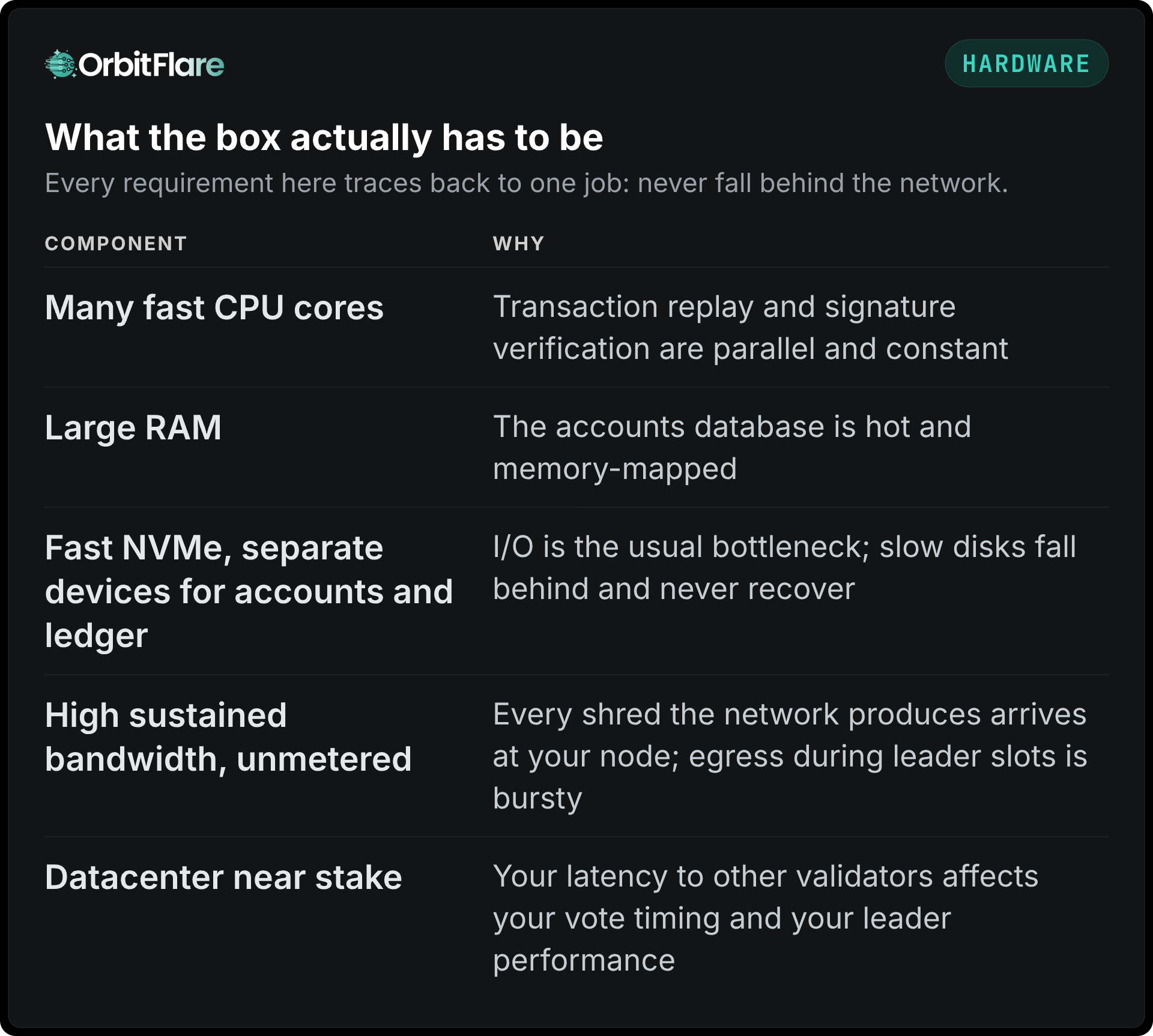
Frankfurt, Amsterdam, and the East coast of the United States are regions with large stake accumulation and validator density because of that. Metered Internet egress is the dominant source of the bandwidth cost in public clouds.
The setup sequence
- Provision your server host: tweak OS (file descriptor limits, network buffer sizes, huge page allocation), provision separate disks for accounts and ledger, provide time synchronization.
- Install your client: official Agave client or a popular Jito-Solana client (which provides MEV capability), or a newer Firedancer-based client. Pin its version; updating should be deliberate and done with care.
- Generate necessary keypairs: for identity, for vote account, and for authorized withdrawer which you store securely offline. Keep identity private key on the node, while withdrawer stays offline.
- Create a vote account with set-up commission and fund the identity account with sufficient amount of SOL to cover vote fees.
- Restore the node starting from snapshot and not from the genesis, allowing it to catch up with the chain tip.
- Check if the node is successfully synced, casting votes and listed in validator list with right commission.
Perform the setup process on testnet first: testnet was created for such purposes (devnet vs mainnet vs testnet). Testing the update and restart processes on the testnet prevents any damage during the process on the mainnet.
Daily operations
Upgrades: clients receive regular updates, some become obligatory by a set deadline. Follow announcement channels, test the update on testnet and perform the upgrade on mainnet in the window selected by you to not coincide with being a leader.
Monitoring: watch for lag compared to the cluster, per epoch vote credits compared to peers, skip rate, delinquency status, disk usage and its rate of growth, network usage, and the SOL balance on the identity account for vote fee. You have to set alerts for all of them; otherwise, validator loses reputation without any notice.
Restarts: schedule them in advance. Restart of the node during its leadership slots leads to skipping of them. Snapshots reduce time required for a restart process, but do not make it instant.
Key maintenance: keypair for authorized withdrawer is used to withdraw rewards from the vote account; make sure this key stays offline. Change the identity key pair only after testing.
Ledger management: as the chain grows, set up retention and pruning parameters, otherwise the disk will fill up and prevent further operation of the node.
The economics
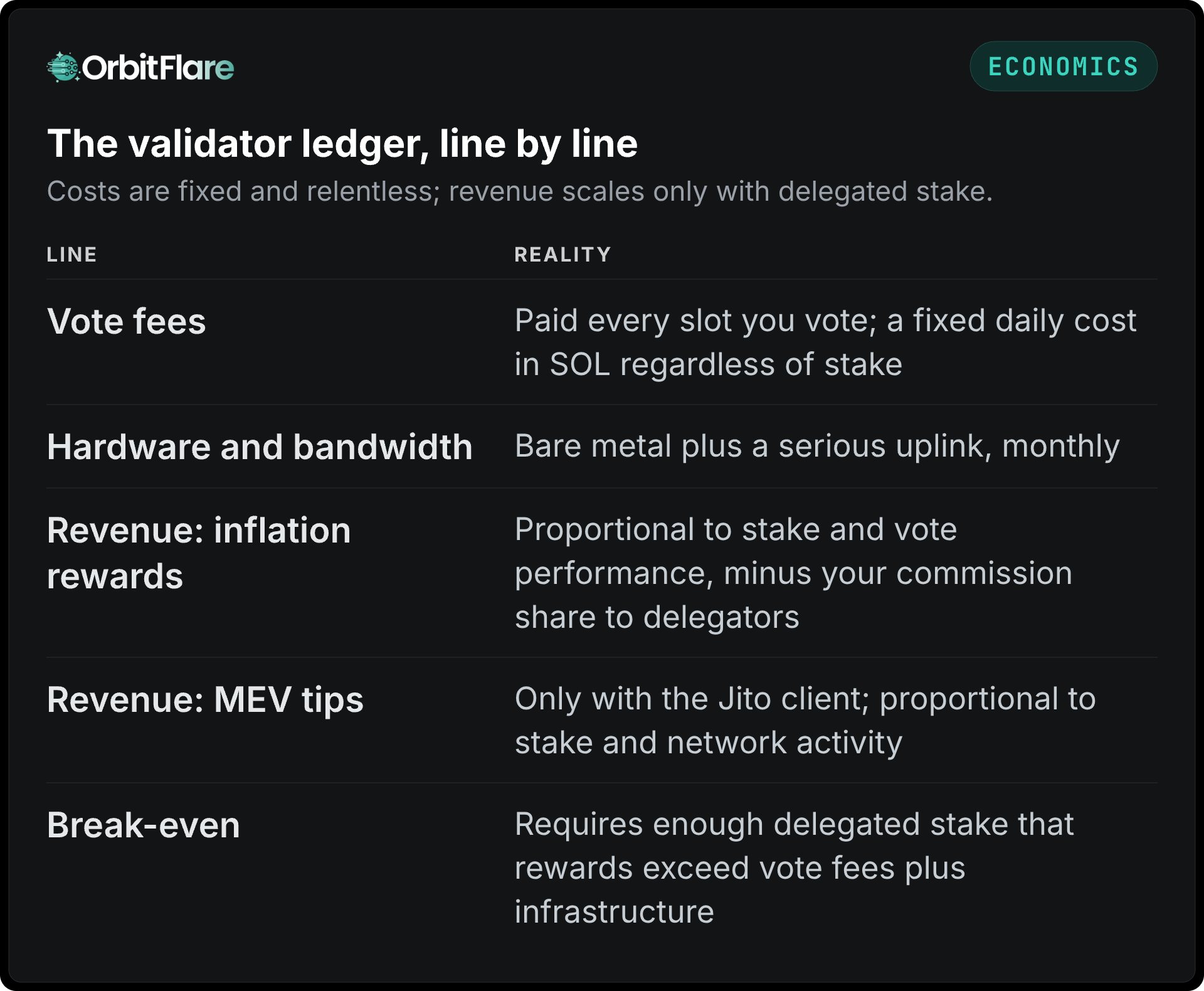
The process of getting profitability starts with losses for new validators. To get stakeholders' trust, you have to present good performance, join available delegation programs, offer reasonable commission without previous bait-and-switch history and operate well for as long as it takes for public metrics to speak for you.
Failure modes
- Synchronization failure because disks or network throughput was chosen by the minimum possible value; node failed to keep up with chain under load.
- Missing obligatory update; validator is disconnected from the cluster.
- Restarting during leader slots and skipping of leader slots due to it.
- Running out of vote fee SOL on the identity account.
- Exposing validator public RPC port and lowering vote performance by doing so.
- Loss of key or online storage of withdrawer key.
All of those failure modes are easily avoided with proper monitoring and runbook, that's why initial testing on testnet is important.
Conclusion
Running a Solana validator is infrastructure business: latest generation bare-metal server close to other stakes, deliberate client selection and provisioning process, testing on testnet and monitoring on lag, skip rate and vote credits thereafter. Only after delegators trust the public metrics, the business starts earning money, and until that, it requires spending some. If your goal is staking yield, delegate it to the validator; if you need a Solana node to run your application, either run a dedicated node or rent RPC access. You have to become a validator only if running one is the goal itself.
OrbitFlare operates Jito-enabled validator you could delegate to, and staking calculator allows you to evaluate your choice before making it.
Resources
- Validator hardware requirements (Agave docs)
- Setup a Solana validator (Agave docs)
- Validator operations best practices (Agave docs)
- Validator monitoring best practices (Agave docs)
- Validator security best practices (Agave docs)
- Validator or RPC node? (Agave docs)
- Jito-Solana and the block engine (Jito docs)
- Firedancer validator client (Firedancer docs)
- Solana Foundation Delegation Program (Solana Foundation)
- Validator performance metrics (Validators.app)
- Solana devnet vs mainnet vs testnet (OrbitFlare)
- Network infrastructure for low-latency Solana trading (OrbitFlare)
- OrbitFlare validator
- OrbitFlare staking calculator
- OrbitFlare Discord
FAQ
Bare-metal hardware with fast NVMe and an unmetered high-bandwidth uplink, plus daily vote fees in SOL. Exact figures depend on the facility and the market; plan for a meaningful monthly cost before any revenue.
Enough that inflation rewards and MEV tips exceed vote fees and infrastructure. It varies with the network's inflation rate and staked share; model it with current numbers rather than a rule of thumb.
Technically, with large instances and local NVMe, but metered egress makes bandwidth expensive and noisy neighbours hurt performance. Most operators run bare metal.
If you want MEV tips for yourself and your delegators, yes. It is the client the majority of stake runs and it is compatible with the network.
Consistently low, in line with or better than the cluster average over several epochs. Spikes indicate restarts or resource problems.
An RPC node, or rented RPC capacity. Validators serve consensus; serving API traffic from one degrades both. OrbitFlare's [dedicated nodes](/products/dedicated-nodes) are the rented path if shared plans are not enough.
How to Run a Solana Validator: Hardware, Setup, Operations and Economics
Related articles
Solana Archive Nodes and Historical Data: What Needs an Archive and How to Use It
Standard Solana nodes keep only days of history. Old blocks, transactions and signatures need an archive tier served through the same RPC methods. Which methods hit the archive, why there is no historical state query, and how to use history efficiently.
FundamentalsSolana Devnet vs Mainnet vs Testnet: Which Cluster for What
Mainnet beta is production, devnet is the developer playground with free SOL, testnet is for the network itself. What each cluster is for, how to point wallets and code at them, what differs in practice, and the mistakes from mixing them up.
FundamentalsSolana RPC Rate Limits: How They Work and How to Stop Hitting Them
Rate limits are a provider mechanism with three shapes: per second, per allowance and per method. How to diagnose which one you hit, and the changes (subscribe instead of poll, batch, cache, slice, fix retries) that cut request volume by an order of magnitude.