

Copy Trading Architecture: Centralized vs Decentralized
Centralized copy trading mirrors trades inside one ledger. Decentralized copy trading watches a public wallet and rebuilds the trade on-chain.
Sourav Mishra · Solutions Engineer
Sep 3, 2026 • 7 min read


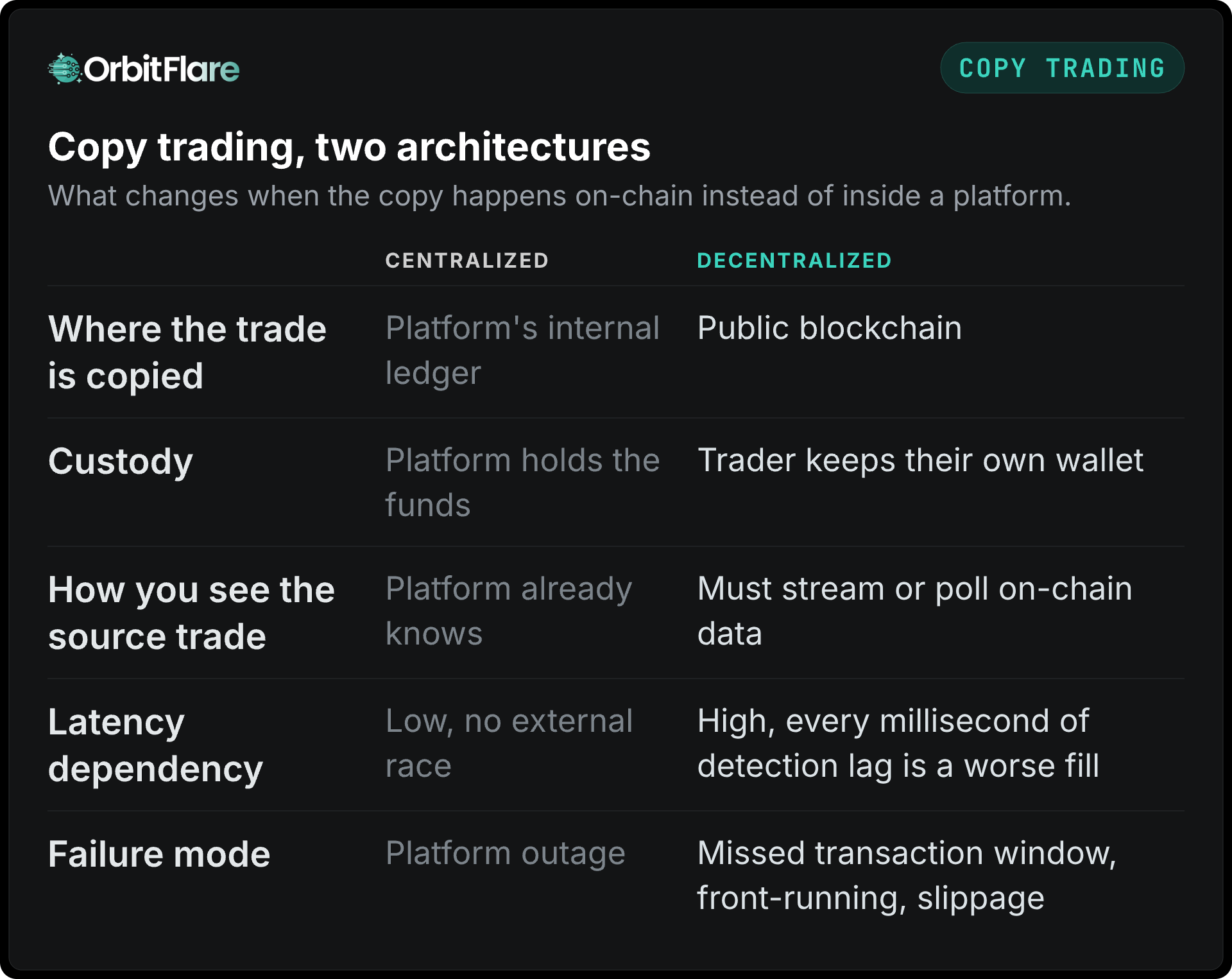
The difference in copy trading architecture centralized vs decentralized lies in the place where the trade is copied: a private platform ledger or a public chain. A centralized platform mirrors trades between accounts which it already controls. A decentralized platform needs to detect a trade outside of its control and submit another one before the window closes.
What's the real architectural difference between centralized and decentralized copy trading?
Centralized copy trading mirrors a trade within the platform's infrastructure without involving blockchain. Decentralized copy trading observes a public wallet on a blockchain, detects an order made by the wallet and executes another one to follow it.
eToro explains the operation principle of its CopyTrader system: you allocate $1,000 to a trader who has $10,000 on their account, and when they open a $1,000 position, a $100 position opens automatically in your account. It is proportional, executed on the platform's infrastructure and custodial. There is no wallet to monitor since the platform sees everything in advance.
Decentralized copy trading doesn't allow any of that visibility. The wallet's transactions arrive on the public ledger and nothing will push them to you, so you have to retrieve transactions yourself and fast enough that there is still a time to submit a copy trade.
How does a decentralized copy trading platform's architecture actually work?
This is a combination of a detection layer and an execution layer, and almost all mistakes are made on the detection layer, by failing to see a transaction in time. The platform should see the transaction instantly, decode the trade and execute it before it is too late.
The problem lies with the detection layer. Polling an RPC endpoint for signatures of the wallet works theoretically until you realize that you miss the trades and you receive updates periodically. OrbitFlare's own trader infrastructure page states that "Copy trading fails on latency and on gaps. Polling getSignaturesForAddress means you find out after the fact and miss anything that lands between calls." The fix for that is a push model, a gRPC stream filtered by an account id server-side so that you receive transactions instantly.
The execution layer then needs to submit a copy trade fast and protect from front-running. Here the MEV protection becomes useful, since Jito bundles offer fast landing and revert protection, so a copy trade transaction either lands or fails without costing you the position.
How do you actually build a copy trading platform on blockchain?
Three components must operate to submit a trade: a low-latency data stream for detecting the trades of the source wallet, a decoder which understands the instructions of the DEX, and an execution pipeline which submits the trade quickly enough. A failure in any one of the components renders useless the rest of them.
We made a working example of this exact architecture available instead of just explaining it. solana-copy-trader template uses Jetstream instead of polling, can decode swaps across Jupiter, Raydium, and Pump.fun, and uses Jito MEV protection so that a copy trade lands safely without risking getting sandwiched. The platform is written with Rust, Tokio, gRPC and Redis, not because this is an unusual tech stack, but because copy trading is a streaming problem first and this is the stack which is efficient at processing a constant flow of transactions in real time without falling behind. The majority of copy-trading bots in the wild are broken at the decoding step, because they can decode swaps of one DEX and silently miss trades routed to any other DEX.
What does the future of decentralized copy trading look like?
More and more platforms will switch to the streaming model because the platforms which copy trades one block late will keep losing fills to the platforms which use the streaming infrastructure. The copy trading infrastructure will become the question not of whether it should be decentralized or not, but how much latency it can tolerate depending on the strategy being followed. A slow-moving position tracker can get away with polling, but a sniper copy trade bot cannot.
The best copy trading platforms, centralized or decentralized, converge to the same requirement: the platform must see the source event instantly, not on the next scheduled update. This is true regardless of whether you run a copy trading platform for retail followers or a copy bot for a specific strategy, because the infrastructure underlying the crypto copy trading platform is increasingly becoming the same as the infrastructure for market data.
Frequently asked questions
Is decentralized copy trading always better than centralized? Not necessarily. It trades the simplicity of the platform for the non-custodial feature and the ability to verify transactions publicly at the expense of the necessity to implement an infrastructure for detecting and racing on the blockchain transactions.
What is the minimal latency a decentralized copy trading platform needs? There is no definite answer, because the latency requirements depend on the specific strategy being implemented.
Want to see how the infrastructure of streaming-based copy trading looks in reality? OrbitFlare's trader solutions cover RPC, gRPC and Shredstream products which are commonly used for building such a bot.
Resources
FAQ
A centralized platform copies trades inside its own account system with no blockchain involved. A decentralized platform watches a public wallet's on-chain activity and races to submit a matching transaction before the window closes.
It combines a detection layer that streams a target wallet's transactions in real time (rather than polling) with an execution layer that lands the copy transaction quickly and safely, often using MEV-protected bundles.
You need a low-latency streaming data feed, a decoder that understands the DEXs the source wallet trades on, and an execution path that lands the copy transaction fast, typically with MEV protection.
Copy Trading Architecture: Centralized vs Decentralized
Related articles
Agave 4.2: Transaction V1 Breaking Changes Checklist
Six things that break when Transaction V1 activates on Solana mainnet, and only one of them throws an error. What fails, how it fails, what to change, and the library versions to pin.
DevelopersNFT Indexing on Solana: The DAS API, Compressed NFTs and Custom Indexers
Compressed NFTs made NFT indexing a provider service: their data lives in transaction logs, not accounts. The DAS API answers ownership, metadata, collection and proof queries across every NFT kind. When to use it and when to build your own index.
DevelopersSolana Priority Fee Estimation: A Method That Lands Without Overpaying
The right priority fee is the price per compute unit recent transactions on your accounts paid, at a percentile matching your urgency, times a compute limit set from simulation. The method step by step, and the mistakes that make bots overpay or fail to land.